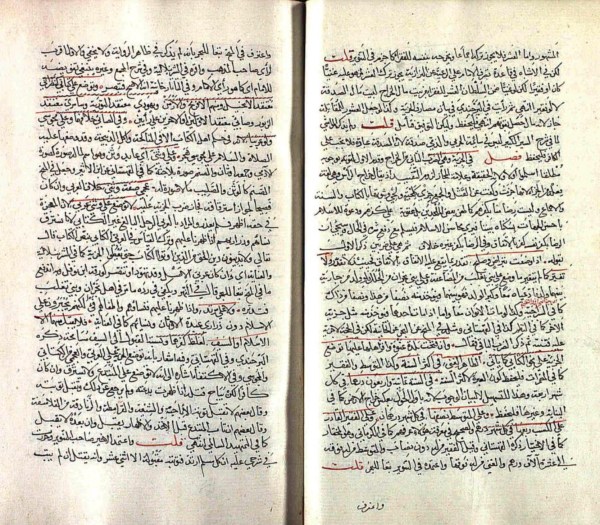
Studying fiqh poses challenges for modern Muslims, who often adapt Islamic law to fit secular perspectives. Traditional fiqh manuals illustrate a time when Muslims confidently practised shari'ah. Imam Haskafi’s insights on jizyah highlight its role as a form of da’wah, showcasing Islamic justice. Understanding these principles is vital for re-evaluating contemporary Islamic thought.
Fasaha & Balagha
Fasaha in mufradaat (words/phrases) is for a word to be in accordance with the rules that are derived from surveying the language of the Arabs, while the letters are appropriate to one another and it is prevalently used. In accordance with the rules – e.g. according to sarf rules it would be inappropriate to say... Continue Reading →
The importance of the science of balagha
“…the sciences of Balagha and its associated sciences are from the most exalted of sciences in terms of rank and the most subtle of them in terms of intricacies, because by them the intricacies of the Arabic language and its secrets are known, and the coverings are removed from the angles of miraculousness within the... Continue Reading →
جواب على الاسلوب الحكيم
And they say, "Why is a sign not sent down to him from his Lord?" So say, "The unseen is only for Allah [to administer], so wait; indeed, I am with you among those who wait." [Yunus:20] Some questions are not meant to be answered directly because the intention behind the question is not what... Continue Reading →
The B-theory of time, creation ex-nihilo, Craig & “kalam”
My article The Ghazalian response to deniers of causality led to some interesting discussions on Facebook . One of the contentions raised relate to a certain view of time, known as the B-theory of time, which imagines the universe as a 4-D space-time block. Matter/energy is distributed across this space-time continuum and a single point... Continue Reading →
“Scientific errors” in the Qur’an and the issue of language
The Qur'an allegedly contains "scientific errors". But, to me, it seems like these "scientific errors" are forced upon the Qur'an by people who probably have no idea how to read it. To properly appreciate the rich meanings contained in the Qur'an, there are a number of important aspects to consider, the most fundamental of which... Continue Reading →
Limits, finitude and dependence
In his argument for God's existence, Shaykh Taqiuddin an-Nabhani says that things that we can perceive and comprehend are limited, hence dependent on other than themselves. But why must limited things necessarily be dependent? And how do we know? The answer lies in the precise choice and ordering of words by the Shaykh. He says:... Continue Reading →
The Banu Qurayza incident and the critics of Islam
The Banu Qurayza issue is a favourite of the critics of Islam. An enitre Jewish tribe was put to the sword, sparing only the women and children, who were enslaved instead. I can understand that many will find this incident shocking. However, what I find superficial is the conclusion that is drawn that Islam is... Continue Reading →
Is Islam a “reasonable belief”?
So...do I reason Islam? Or Islamify reason? Do I make belief reasonable? Or make reason believable? Or do I simply believe belief... And reason reason? The below is the transcript of a talk delivered last year at an event titled "Is Islam a reasonable belief?" The question we want to address tonight is... Continue Reading →
Shaykh Taqi’s argument for the existence of a creator
Shaykh Taqiuddin an-Nabhani’s (may Allah have mercy on him) argument for the existence of a creator is best summarised in the brief paragraph below from his concise, yet profound, book Nidham ul-Islam: “The reason that things must have a creator, is because the things which are comprehensible by the mind that is man, life, and... Continue Reading →